Education Through Experience

THE CHARLES ELLIS
LIVED EXPERIENCE CURRICULUM

A Literary Inquiry Curriculum Rooted in Lived Experience

Curriculum I: Beneath My Eyes

The Charles Ellis Lived Experience Curriculum uses poetry and lived experience as primary literary texts for rigorous inquiry, interdisciplinary exploration, critical thinking, evidence-based reasoning, reflection, and creative response.

This is more than a lecture or poetry reading. Participants engage with literature, lived experience, thoughtful questioning, written reflection, and facilitated conversation in an environment designed to encourage meaningful dialogue and personal examination.

The Foundational Curriculum

Curriculum I:
Beneath My Eyes

Built around selected writings from Charles Ellis's Beneath My Eyes, Curriculum I uses poetry and lived experience as primary texts for examining the experiences, choices, relationships, environments, history, and circumstances that shape a person's life.

Participants are encouraged to read, question, discuss, reflect, make connections, and examine how themes within the literature relate to individual experience and the larger world around them.

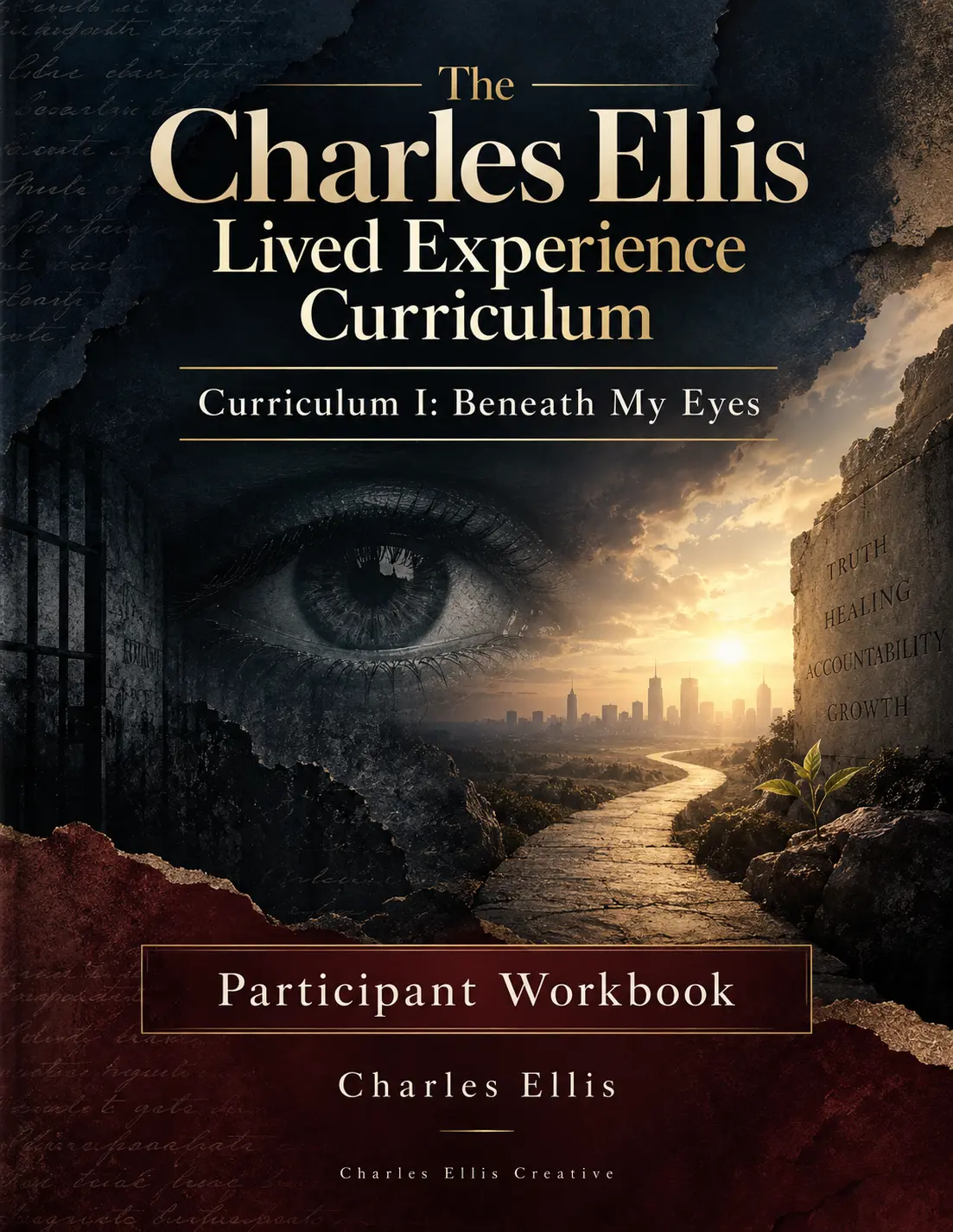
Curriculum I Beneath My Eyes Participant Workbook cover
Participant WorkbookRequired for every participant
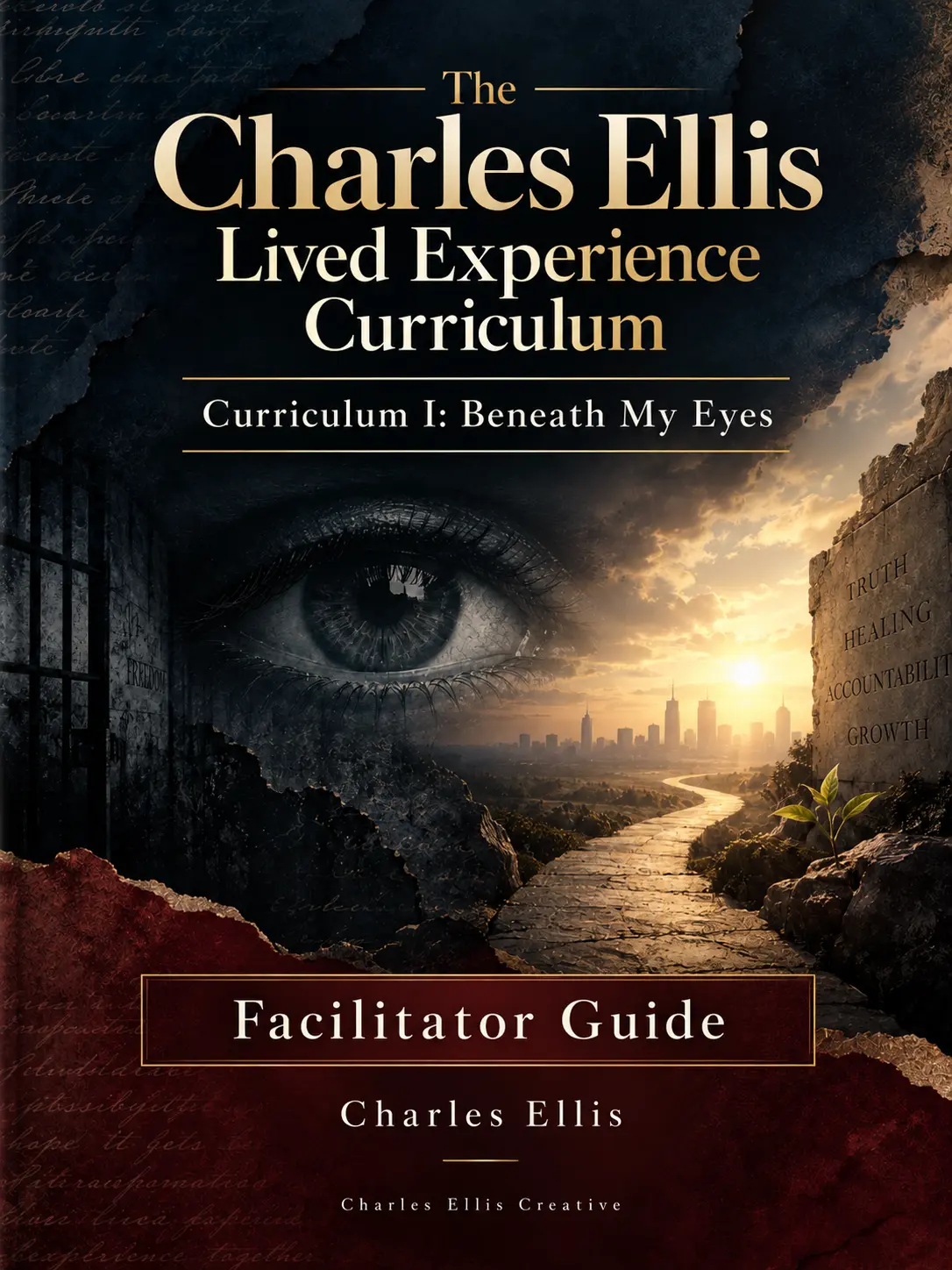
Curriculum I Beneath My Eyes Facilitator Guide cover
Facilitator GuideStructured delivery by format
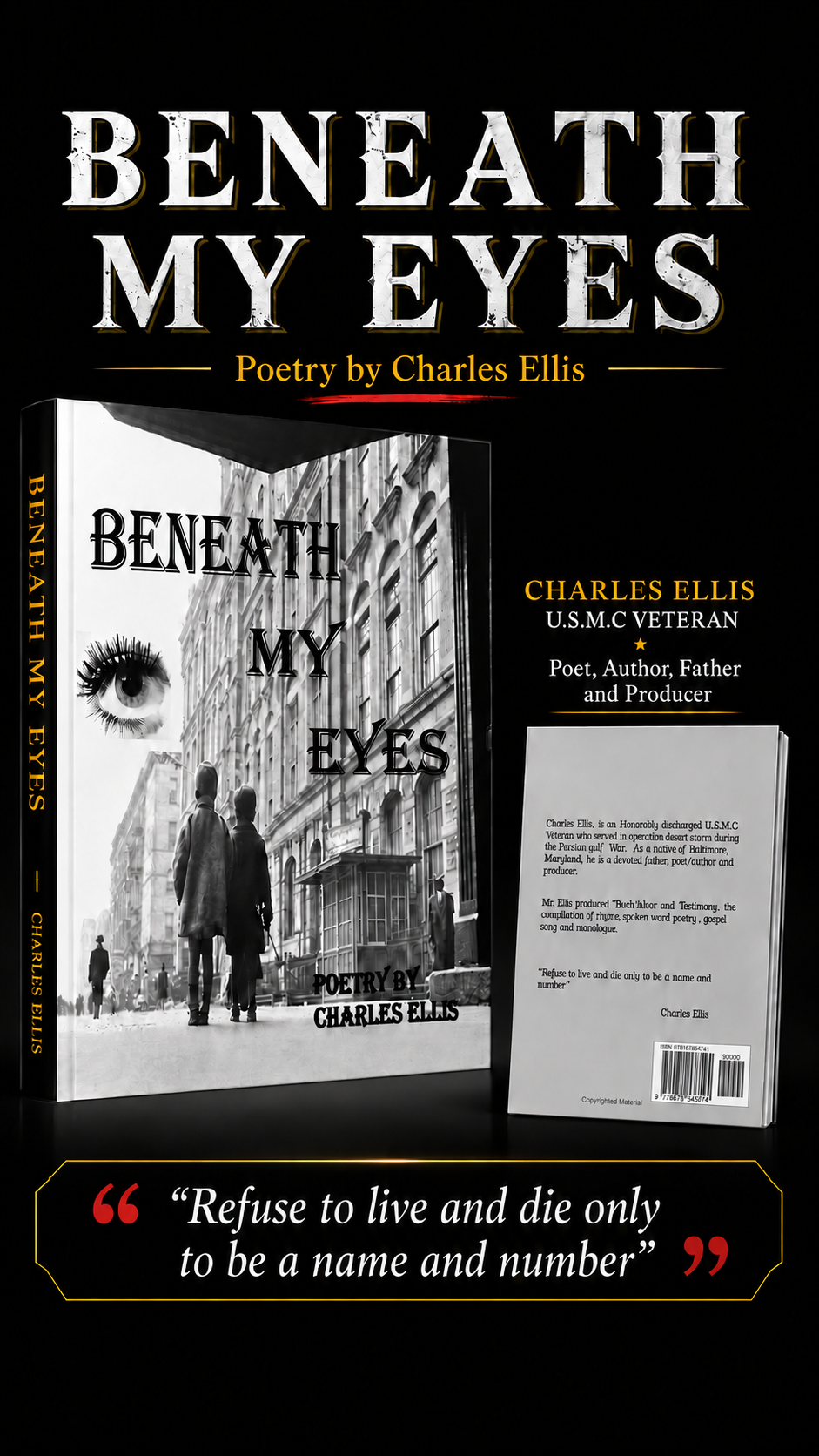
Beneath My Eyes poetry book by Charles Ellis

Optional Supplemental Text

Beneath My Eyes

The selected poems required for instruction are included in the Participant Workbook. The complete book may be added to institutional packages for extended study, gifts, or take-home reading.

Participant Workbook: Required  ·  Beneath My Eyes: Optional

Required Participant Materials

One primary learning resource. One focused experience.

Every participant is required to have a Participant Workbook.

The Participant Workbook contains the selected poems, discussion material, reflection exercises, and curriculum content needed during the facilitated program.

The original book Beneath My Eyes is optional supplemental reading because the selected poems needed during instruction are included directly in the workbook. This keeps participants focused within one primary learning resource instead of moving back and forth between materials.

Copies of Beneath My Eyes may still be added to an institutional package as supplemental reading, extended study material, gifts, or take-home resources.

What Participants Experience

Inquiry that invites people to examine—not simply accept.

The curriculum encourages dialogue, interpretation, connection, and reflection rather than giving participants predetermined answers.

Selected poetry and literary textsLived-experience narrativeFacilitated discussionCritical thinking and interpretationWritten participant reflectionGuided workbook exercisesAccountability and decision-makingIdentity and personal growthRelationships and life experiencesSocial and historical connections

How the Curriculum Works

Literature opens the door. Reflection carries the learning forward.

Modules are organized around carefully selected anchor poems, with supporting literary texts used when appropriate.

Each module may include:

  • Anchor poem and supporting literary material
  • Learning objectives and lived-experience context
  • Facilitated discussion and workbook exercises
  • Reflection and educational or historical context when relevant
  • Closing application or integration

Complete facilitator instructions, scripts, lesson plans, answer guidance, and proprietary exercises are protected program materials and are not published online.

Approved Delivery Formats

Structured to meet the room, the goals, and the available time.

01

90-Minute Presentation

A focused introduction using a selected anchor text, Charles Ellis's lived-experience perspective, guided discussion, participant reflection, and question-and-answer time.

Best for introductory institutional programs, classrooms, conferences, community programs, and shorter engagements.
02

120-Minute Presentation

Additional time for deeper literary exploration, facilitated discussion, workbook reflection, and structured participant interaction.

Participants have greater opportunity to connect the selected text, lived experience, and their own perspectives.
03

3-Hour Intensive

An immersive experience with multiple instructional segments, selected literary material, guided discussion, workbook exercises, written reflection, and facilitated application.

Provides significantly more curriculum interaction than a presentation-only experience.
04

Full-Day Program

A comprehensive experience using multiple learning blocks, selected poems and supporting material, participant exercises, discussion, reflection, breaks, and closing integration.

Allows themes to be explored with greater depth rather than compressed into a shorter session.
05

Up-to-One-Week Presentation / Intensive

The most comprehensive delivery format. Content is divided across multiple sessions or days so participants can explore several themes, complete more substantial workbook exercises, revisit discussions, deepen reflection, and build toward a culminating educational experience.

Longer formats allow greater depth in literary analysis, interdisciplinary inquiry, research connections, structured discussion, writing, creative work, and culminating presentations or projects. Faith-based adaptations are available where appropriate.

Planning Your Curriculum Engagement

Preparation protects the quality of the experience.

10Standard Minimum
Participants

Curriculum engagements are designed for groups of 10 or more participants. Smaller-group engagements may be considered based on program format, location, and organizational needs. Larger-group requests are evaluated according to format, room structure, breakout needs, and facilitation requirements.

60 days' advance notice is preferred.

This allows time for Participant Workbook production, material preparation, customization, shipping, travel planning, and program coordination. Shorter-notice requests may be considered based on availability and production timelines.

Organizations should provide an estimated participant count during the initial inquiry and normally confirm the final count approximately 30 days before the engagement. Accessibility needs, technology requirements, security procedures, room limitations, institutional policies, faith-based requirements, and audience-specific considerations should be disclosed during planning. Multi-day and intensive programs should have a designated organizational contact.

Adapted With Purpose

Standard and faith-based options.

Standard / Secular Institutional Settings

Structured for educational, rehabilitation, professional, community, correctional, and treatment environments.

Faith-Based Settings

Faith-based programming is available as an intentional adaptation when it fits the organization's setting and goals. It is not the default curriculum.

Black History, Literature & Lived Experience

Memory becomes evidence when people are given room to speak.

Black history, race, memory, identity, cultural preservation, family, resilience, and repair may be explored within the broader Charles Ellis Lived Experience Curriculum.

A dedicated standalone Black History educational experience is being developed under the curriculum umbrella, with Charles Ellis's poem “Bush Arbor” from A Lion Sleeps in Judah serving as a major literary doorway into discussions of Black history, generational memory, culture, faith, family, survival, identity, and historical preservation.

This standalone curriculum is currently in development.

Explore Black History Speaking
Experience the Curriculum

A rigorous inquiry model—made visible.

Prospective institutions and organizations can explore a representative sample of the instructional model used in Curriculum I: Beneath My Eyes. The sample demonstrates literary inquiry, interdisciplinary analysis, participant reflection, facilitator instruction, competing perspectives, and evidence-based reasoning.

Sample curriculum preview — for program evaluation.

This preview demonstrates methodology and rigor without publishing the complete proprietary curriculum.

View Curriculum SampleOpen the institutional preview

Sample Curriculum Experience

“30 to Life”

Central Inquiry

How does a person change across a lifetime, and how should we understand the relationship between circumstances, development, choices, consequences, responsibility, and the possibility of change?

“30 to Life” is used as an anchor literary text from Beneath My Eyes. The full poem is not reproduced in this public sample.

Signature Instructional Framework

READ INTERPRET QUESTION CONNECT CREATE RECONSIDER

READ

Examine the literary work closely.

INTERPRET

Develop meaning using textual evidence.

QUESTION

Challenge assumptions, claims, and interpretations.

CONNECT

Bring literature into conversation with relevant academic disciplines and lived experience.

CREATE

Demonstrate understanding through original analytical, reflective, literary, or creative work.

RECONSIDER

Return to the original interpretation after encountering new evidence or perspectives.

Learning Objectives

Evidence before conclusion.

Participants are expected to support conclusions with evidence rather than simply state opinions.

  • Literary analysis
  • Evidence-based interpretation
  • Competing interpretations
  • Critical thinking
  • Human-development analysis
  • Interdisciplinary inquiry
  • Responsibility and context
  • Lived experience as knowledge
  • Reflection and revision of ideas

Developmental Arc

Six movements through a changing life.

I

Innocence & Vulnerability

What does the text reveal about the person before later experiences begin changing the way he understands himself and the world around him?

II

Neglect, Conflict & Exposure

What happens when a person's environment begins exposing him to experiences he may not yet have the ability to process?

III

Violence, Survival & Adaptation

When does a behavior that once functioned as protection begin creating new dangers?

IV

Deterioration, Choice & Consequence

How should we evaluate a decision when both individual choice and surrounding circumstances matter?

V

Isolation, Consequence & Reckoning

What happens to identity when a person is forced to confront the consequences of earlier decisions?

VI

Renewal, Meaning & Transformation

What constitutes meaningful change?

Wisdom Faith Patience Love Peace
Participant Workbook Sample

Evidence From the Text

What passage, image, or moment stands out to you?

Interpretation

What do you believe this passage reveals about the speaker?

Evidence

What specific evidence supports your interpretation?

Competing Perspective

What might someone who disagrees with your interpretation say?

Reconsider

Has your interpretation changed after considering another perspective? Why or why not?

Visual sample only. Responses are not collected on this website.

Multiple Lenses. Deeper Questions.

Disciplines are selected with purpose.

Appropriate portions of the curriculum may draw from literary analysis, psychology and human development, sociology, justice and legal inquiry, education, ethics, history and culture, and lived experience. Every lens is not forced into every lesson; perspectives are selected according to the literary text, central inquiry, and learning objectives.

Literary AnalysisPsychology & Human DevelopmentSociologyJustice & Legal InquiryEducationEthicsHistory & CultureLived Experience

Important Academic Distinctions

Understanding context is not the same as excusing behavior.

Participants may make evidence-based inferences about perspective, emotional state, motivation, conflict, or coping, but the curriculum does not ask participants to diagnose the author or literary speaker.

Lived experience is a meaningful source of knowledge, but one person's experience does not automatically establish the experience of an entire group.

Competing Perspectives Sample

Three credible positions. One evidence-based conclusion.

Perspective One

The speaker's later choices cannot be fully understood without examining the experiences that preceded them.

Perspective Two

Regardless of previous experiences, individuals remain responsible for the choices they ultimately make.

Perspective Three

Personal responsibility and environmental influence can operate at the same time.

Which interpretation is most strongly supported by the text, and what evidence supports your conclusion?
Facilitator Guide Sample

Participant Workbook Says:

How should we understand the relationship between circumstances and responsibility?

Facilitator Instructions:

Do not immediately supply an answer.

Allow participants to establish initial positions.

Ask: What in the text led you to that conclusion?

If a participant makes a broad claim, ask: What evidence supports that?

If everyone agrees too quickly, introduce a credible competing interpretation and ask: What might someone who disagrees with us say?

The facilitator's responsibility is not to create agreement, but to guide rigorous, respectful, evidence-based inquiry.

Key Term Teaching Sample

Academic accuracy. Accessible instruction.

Agency

Definition: An individual's capacity to make choices and act upon them.

Plain-Language Explanation: Having some ability to make decisions about what you do.

Context

Definition: The circumstances, conditions, background, or setting surrounding an event, statement, decision, or experience.

Plain-Language Explanation: What was happening around something that helps us understand it more completely.

Inference

Definition: A conclusion reached from evidence and reasoning rather than from something directly stated.

Plain-Language Explanation: What you reasonably figure out from the clues you have.

Author as a Living Text

When the written work and the person behind it share the room.

In author-led presentations, participants may have access to both the written literary work and the person whose lived experiences contributed to that work. This distinctive feature opens further inquiry:

  • Can readers discover meanings the author did not consciously intend?
  • Can an author reinterpret his own earlier work?
  • How does memory affect storytelling?
  • Is the author's interpretation automatically the only valid literary interpretation?

Create & Reconsider

The Turning Point

Choose one significant turning point from the literary work and examine:

  1. What occurred?
  2. What conditions existed beforehand?
  3. What choices were available?
  4. What consequences followed?
  5. What alternative path might reasonably have existed?
  6. What evidence supports your analysis?

Reconsideration

Before this inquiry, I thought...

After examining the text and competing perspectives, I now think...

The strongest evidence influencing me was...

One question I am leaving with is...

“A person's past helps explain who they became, but it does not have to determine who they remain.”

Participants develop a position using evidence from the literary text, at least one competing interpretation, one relevant interdisciplinary perspective, reasoning connecting evidence to conclusion, and one limitation or unanswered question.

Curriculum Materials

Two coordinated resources. One instructional system.

The Participant Workbook is the primary participant resource. The Facilitator Guide provides coordinated instructional support while remaining clearly distinct. The original Beneath My Eyes book is available as optional supplemental reading.

Participant Workbook
Participant Workbook Required
Facilitator Guide
Facilitator Guide Companion
Beneath My Eyes book
Beneath My Eyes Optional supplemental text

Bring The Charles Ellis Lived Experience Curriculum to Your Organization

Build the right experience for your participants.

Program structure, presentation format, participant materials, books, curriculum resources, and pricing are customized according to the needs and goals of each organization.

The Facilitator Guide

Structured by format. Protected by design.

The program is supported by a structured Facilitator Guide with dedicated delivery sections for every approved format. Each section is designed to contain its own timing map, required segments, learning objectives, selected material, discussion blocks, exercises, transitions, breaks where applicable, required participant materials, and closing activities.

Those detailed instructions and proprietary delivery methods are not published on the public website.

Why Lived Experience

Experience examined becomes a resource for learning.

Charles Ellis brings together authorship, poetry, lived experience, facilitation, military experience, personal accountability, transformation, and years of examining how experience influences identity, choices, relationships, and growth.

Learn More About Charles Ellis

Organizations & Settings

Designed for learning wherever meaningful examination can happen.

Higher EducationRehabilitation & RecoveryReentry ProgramsCorrectional SettingsYouth DevelopmentCommunity OrganizationsLibrariesCultural OrganizationsProfessional DevelopmentFaith-Based OrganizationsTreatment ProgramsEducational Institutions

Customized Curriculum Proposals

Built around your organization.

Each engagement is customized according to the organization, audience, delivery format, location, participant count, required Participant Workbooks, travel, materials, institutional needs, and level of program customization.

Request a Curriculum Proposal

Booking Deposit

Securing a program date.

All confirmed curriculum engagements require an initial non-refundable deposit to secure the requested date. The remaining balance and payment schedule will be outlined in the customized proposal and engagement agreement.

Submitting an inquiry does not reserve or hold a program date. A date is secured only after the required agreement has been completed and the initial non-refundable deposit has been received.

Begin the Conversation

Curriculum Inquiry

Tell us about your organization, participants, goals, and preferred format. Your information will be reviewed so an appropriate program and customized proposal can be prepared.

Organization & Contact
Participants & Program
Goals & Planning Considerations

Submitting this inquiry does not reserve a program date. Charles Ellis Creative will review your information and follow up regarding recommendations, availability, materials, and a customized proposal.

Charles Ellis Creative

Bring the Experience to Your Organization

Every institution, audience, and setting is different.

The Charles Ellis Lived Experience Curriculum can be structured around your participants, educational goals, available timeframe, and organizational needs.

Request a Customized Curriculum Proposal